

High-Performance Remote Teams is build for Global Businesses
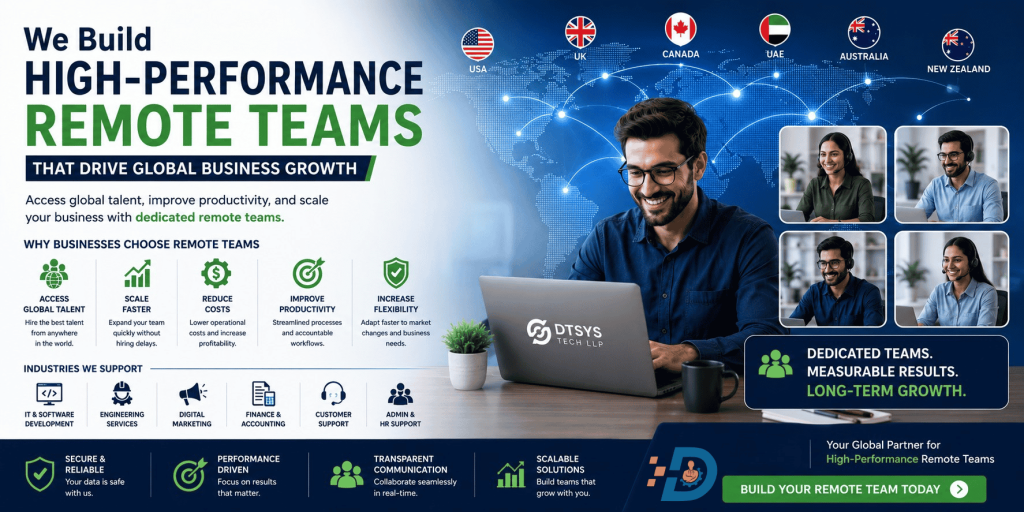
We Build High-Performance Remote Teams That Power Global Business Growth Discover how high-performance remote teams help businesses access global talent, improve productivity, and scale faster with flexible workforce solutions. DTSYS Tech June 9, 2026 7:21 am Why Businesses Worldwide Are Replacing Traditional Hiring with High-Performance Remote Teams The way businesses build teams is changing forever. Companies are no longer asking, “Where can we find talent?” Instead, they’re asking: “How can we build a high-performance team that scales with our business?” In today’s economy, speed, flexibility, and execution determine success. Businesses that rely entirely on traditional hiring models often struggle to keep up with growing market demands. Lengthy recruitment cycles, workforce shortages, increasing labour costs, and operational inefficiencies are forcing organizations to rethink how they build teams. This is why companies across the globe are investing in high-performance remote teams. Remote team building is no longer a trend. It has become a modern business growth strategy that helps organizations scale faster, operate efficiently, and remain competitive in a rapidly evolving marketplace. Why Traditional Teams Are No Longer Enough Businesses today face challenges that didn’t exist a decade ago. Markets move faster. Customer expectations are higher. Technology evolves daily. Yet many companies still rely on workforce models designed for a different era. Common challenges include: Slow hiring processes Talent shortages Increasing operational costs Employee turnover Limited scalability Productivity bottlenecks These issues create friction that slows down business growth. The businesses growing the fastest are solving these problems with high-performance remote teams. What Is a High-Performance Remote Team? A high-performance remote team is a dedicated workforce designed to operate as a seamless extension of your business. It is not a group of freelancers working independently. It is a structured team that works together with clear goals, accountability systems, and performance-driven processes. High-performance remote teams are built around: ✅ Defined responsibilities ✅ Measurable KPIs ✅ Efficient communication ✅ Operational transparency ✅ Long-term business objectives The result is a workforce that consistently delivers outcomes. Why Businesses Worldwide Are Building High-Performance Remote Teams Modern businesses need agility. Companies that can adapt quickly gain a significant advantage. High-performance remote teams help businesses: Access Global Talent Find skilled professionals regardless of location. Scale Faster Expand departments without lengthy recruitment delays. Improve Productivity Build focused teams that deliver measurable outcomes. Reduce Operational Complexity Simplify workforce expansion without increasing overhead. Strengthen Business Resilience Build teams that can adapt to changing market demands. This allows organizations to grow sustainably without traditional workforce limitations. The Difference Between Remote Workers and High-Performance Remote Teams Many businesses make the mistake of simply hiring remote employees. However, successful companies build systems around their teams. A remote worker completes tasks. A high-performance remote team drives business growth. The difference lies in: Structured onboarding Defined workflows Performance tracking Collaboration systems Long-term integration When these elements are in place, remote teams become growth engines. Which Businesses Benefit the Most? High-performance remote teams support businesses across every industry. IT & Software Development Developers, QA engineers, technical specialists, and designers. ESG Consulting We provide effective ESG consulting services to help businesses achieve compliance, sustainability, and long-term value creation. Engineering Services Project engineers, CAD designers, estimators, and consultants. Digital Marketing SEO experts, PPC specialists, content creators, and social media managers. Finance & Accounting Bookkeepers, accountants, analysts, and reporting professionals. Administrative & HR Support Recruiters, coordinators, and operations professionals. No matter the industry, scalable remote teams create operational fle Why Businesses Are Looking Beyond Borders The world’s most successful businesses no longer limit themselves to local talent pools. Instead, they build global teams that allow them to: Operate faster Enter new markets Support larger clients Expand services quickly Increase operational capacity Business growth is no longer tied to geography. It is tied to access, speed, and execution. Why India Has Become a Global Remote Workforce Hub India has emerged as one of the most trusted locations for building dedicated remote teams. Global businesses choose India because of: Large skilled workforce Technical expertise Strong communication skills International business exposure Workforce scalability India provides businesses with the ability to build high-performing teams quickly and efficiently. How DTSYS Tech Builds High-Performance Remote Teams At DTSYS Tech, we help businesses build dedicated remote teams that align with long-term growth goals. Our process includes: Step 1: Understand Business Requirements We assess your goals, workflows, and team requirements. Step 2: Source Qualified Talent We identify skilled professionals aligned with your business. Step 3: Build Your Team We create dedicated teams that integrate with your operations. Step 4: Onboard & Implement Systems We establish communication channels and workflows. Step 5: Performance Management We continuously monitor productivity and outcomes. This ensures your remote team operates efficiently from day one. The Future of Business Is Built on High-Performance Teams The businesses dominating tomorrow are making workforce decisions today. They are choosing: ✔️ Flexibility over rigid structures ✔️ Global talent over local limitations ✔️ Scalability over slow growth ✔️ Performance over headcount Building a high-performance remote team is no longer an advantage. It is becoming a necessity. Final Thoughts Businesses that want to scale sustainably need workforce models designed for the future. High-performance remote teams provide access to global talent, improve efficiency, and help businesses grow without traditional hiring barriers. At DTSYS Tech, we help organizations build dedicated remote teams that support long-term success and measurable business outcomes. Ready to Build Your High-Performance Remote Team? Partner with DTSYS Tech and build a team that scales with your business. 👉 Book a Free Consultation 👉 Build Your Dedicated Remote Team 👉 Start Growing Globally Follow Us On : Facebook Instagram Linkedin Frequently Asked Questions About High-Performance Remote Teams 1. What is a high-performance remote team? A high-performance remote team is a structured group of specialized global professionals managed through clear goals, automated tracking systems, explicit workflow pipelines, and rigorous performance accountability. Unlike standalone freelancers, these teams serve as an integrated digital extension of a business. 2. How can remote team building help businesses grow? Remote team building drives business growth by bypassing local recruitment limitations,
How Hiring Delays Are Slowing Business Growth in Australia
Hiring Delays Are Costing Australian Businesses Revenue and Growth Discover how slow recruitment processes impact Australian businesses and how remote team building helps companies scale faster and reduce hiring delays. DTSYS Tech May 25, 2026 5:28 am The Hidden Business Problem Most Companies Ignore Every growing business understands the importance of hiring the right people. But in Australia, business growth hiring challenges Australia that is quietly affecting revenue, productivity, and scalability: Hiring delays. What many businesses fail to realize is that slow recruitment processes don’t just delay hiring—they delay business growth itself. In today’s competitive market, every week spent searching for talent can result in: Lost revenue opportunities Delayed projects Slower customer delivery Increased employee pressure Reduced operational efficiency In 2026, businesses that cannot hire quickly are struggling to scale efficiently. Why Hiring Delays Are Increasing Across Australia Australian businesses across industries are experiencing slower recruitment cycles due to: Skilled workforce shortages Increased competition for talent Lengthy interview processes Rising hiring expectations Limited local talent availability Industries most affected include: IT & software development Engineering ESG Consulting Finance & accounting Digital marketing Renewable energy sectors As competition for skilled professionals grows, businesses are taking longer than ever to fill critical roles. The Real Impact of Slow Recruitment Processes Many companies underestimate the financial impact of delayed hiring. However, every unfilled position creates operational gaps that directly affect business performance. 1. Delayed Hiring Slows Revenue Generation Businesses generate revenue through execution. When important roles remain vacant: Sales opportunities get delayed Client projects slow down Marketing campaigns stall Operational capacity decreases This directly impacts business growth and monthly revenue performance. For startups and scaling companies, delayed execution can create serious competitive disadvantages. 2. Existing Employees Become Overloaded When businesses cannot hire quickly, current employees are forced to handle additional responsibilities. This often leads to: Reduced productivity Employee burnout Lower work quality Increased stress levels Higher staff turnover Over time, operational efficiency begins declining across departments. 3. Competitors Move Faster Modern businesses operate in highly competitive environments. Companies with faster workforce scalability can:✅ Launch projects sooner✅ Serve more clients✅ Expand operations faster✅ Improve customer response times Meanwhile, businesses stuck in lengthy recruitment cycles often lose valuable market opportunities. 4. Long Hiring Cycles Increase Recruitment Costs Slow recruitment processes are expensive. Businesses spend more on: Recruitment agencies HR management Job advertisements Multiple interview rounds Extended onboarding periods The longer hiring takes, the higher the operational and financial burden becomes. 5. Business Expansion Gets Delayed Hiring delays often stop businesses from: Entering new markets Scaling operations Taking larger projects Expanding service capacity Many Australian businesses are ready to grow—but lack the workforce needed to execute expansion plans quickly. This creates a major scalability bottleneck. Why Traditional Hiring Models Are Becoming Inefficient The modern business environment requires: Faster execution Operational flexibility Scalable workforce solutions Immediate access to skilled professionals Traditional local hiring models often cannot meet these demands efficiently. This is why businesses worldwide are shifting toward: Remote team building and offshore staffing solutions. How Remote Team Building Solves Hiring Delays Dedicated remote teams allow businesses to:✅ Hire faster✅ Access global talent instantly✅ Reduce recruitment timelines✅ Scale operations efficiently✅ Improve workforce flexibility Instead of spending months recruiting locally, companies can deploy skilled professionals much faster through structured remote staffing models. Why Australian Businesses Are Hiring Remote Teams from India India has become a preferred remote staffing destination because of: Large skilled workforce availability Faster recruitment processes Strong technical expertise Cost-effective staffing models English-speaking professionals Australian businesses can quickly scale operations while reducing hiring overhead and workforce delays. How DTSYS Tech Helps Businesses Scale Faster At DTSYS Tech, we help Australian businesses reduce hiring delays by building structured remote teams tailored to operational goals. We provide: IT & software development teams Engineering professionals ESG Consulting Digital marketing specialists Finance & accounting experts Administrative & HR support Our remote staffing solutions help businesses accelerate execution without traditional recruitment bottlenecks. Faster Hiring Creates Faster Growth Businesses that scale successfully are often the ones that build workforce capacity quickly. Structured remote team solutions allow companies to: Improve execution speed Increase productivity Expand operations faster Reduce operational stress Maintain business agility In today’s market, workforce speed is becoming a competitive advantage. Final Thoughts Hiring delays are no longer just an HR issue—they are directly impacting revenue, scalability, and business growth across Australia. Companies relying entirely on slow traditional recruitment processes may continue facing operational bottlenecks and missed opportunities. Remote team building provides a faster, scalable, and more efficient workforce solution for modern businesses. At DTSYS Tech, we help businesses reduce hiring delays and build high-performance remote teams that support long-term growth. Ready to Scale Faster Without Recruitment Delays? Partner with DTSYS Tech LLP and build your dedicated remote team today. 👉 Book a Free Consultation👉 Start Building Your Remote Team Follow Us On : Facebook Instagram Linkedin Frequently Asked Questions About Australian Hiring Delays Why are hiring delays costing Australian businesses their growth? Hiring delays cost business growth by stalling project timelines, causing client churn, forcing staff burnout, and creating massive backlogs in product delivery.When critical roles remain open for months, companies cannot scale and lose major market opportunities to faster competitors. What are the primary causes of slow recruitment cycles in Australia? The primary causes of slow recruitment include severe local talent shortages, unrealistic candidate expectations, complex multi-stage interview protocols, and slow internal hiring approval workflows. These internal and external friction points expand time-to-hire averages drastically across the region. How do prolonged job vacancies impact existing team productivity? Prolonged vacancies severely damage team productivity by forcing existing employees to take on double workloads, which triggers widespread burnout and high turnover. It shifts a company’s focus from growth activities to basic daily damage control. How can global remote staffing eliminate hiring delays? Global remote staffing eliminates hiring delays by bypassing local skills shortages and instantly connecting businesses to massive, pre-vetted international talent pools. This model reduces time-to-hire from several months down to just a few business days. Why should Australian businesses choose offshore
Why Businesses Lose Productivity with Remote Teams in Australia
Why Australian Businesses Lose Productivity with Unstructured Remote Teams Discover why unstructured remote teams reduce productivity and how Australian businesses improve efficiency with structured remote workforce management solutions. DTSYS Tech May 24, 2026 8:28 am Remote Teams Are Growing — But So Are Productivity Problems Remote work productivity challenges Australia has completely transformed how businesses operate across Australia. From startups and agencies to engineering firms and IT companies, businesses are increasingly adopting remote workforce models to reduce costs, access global talent, and improve flexibility. But while remote hiring offers enormous advantages, many businesses are discovering an important reality: Hiring remote employees is easy. Managing them effectively is the real challenge. In 2026, one of the biggest problems Australian businesses face is not remote hiring itself—it’s managing unstructured remote teams. Without proper systems, remote operations quickly become disorganized, inefficient, and difficult to scale. The result? Reduced productivity Communication breakdowns Delayed project execution Operational confusion Missed business goals Why Unstructured Remote Teams Fail Many businesses assume remote work simply means hiring people online and assigning tasks. However, remote workforce management requires: Clear operational systems Defined communication workflows Performance tracking Accountability structures Team coordination processes Without these foundations, productivity begins declining rapidly. The Biggest Remote Team Productivity Problems Businesses Face 1. Lack of Workflow Clarity One of the biggest causes of remote inefficiency is unclear task management. Many remote employees struggle because: Responsibilities are not clearly defined Deadlines constantly shift Priorities change without communication Teams lack structured reporting systems This creates confusion across operations and slows project execution. In remote environments, clarity is productivity. 2. Poor Communication Is Killing Team Performance Communication problems are one of the most common remote workforce management issues in Australia. Businesses often experience: Delayed responses Misunderstood instructions Missed updates Lack of collaboration Without centralized communication systems, remote teams become disconnected from business goals. Successful remote companies rely heavily on: Daily updates Project management tools Team reporting systems Structured communication channels 3. No Performance Tracking Systems Many businesses cannot accurately measure remote productivity. Without KPI tracking and performance monitoring: Accountability decreases Workflow bottlenecks go unnoticed Team efficiency becomes inconsistent This creates management frustration and reduces operational confidence. High-performing remote teams require:✅ Defined KPIs✅ Workflow analytics✅ Productivity tracking✅ Regular performance reviews 4. Time Zone Coordination Challenges Australian businesses working with international remote teams often struggle with: Scheduling conflicts Delayed approvals Workflow interruptions Slow decision-making Without proper workforce planning, teams become reactive rather than productive. Structured remote operations use: Shift coordination systems Dedicated managers Process documentation Clear response timelines This ensures smooth collaboration despite geographical differences. 5. Lack of Team Culture & Accountability Remote employees perform best when they feel connected to the organization. However, many businesses fail to create: Team engagement systems Accountability structures Leadership communication Collaborative environments As a result: Employee motivation decreases Productivity becomes inconsistent Team retention suffers Strong remote culture is critical for long-term operational success. Why Remote Workforce Management Is Becoming a Business Priority As remote hiring grows globally, businesses are realizing: Productivity depends on structure—not location. Companies with well-managed remote teams often outperform traditional office-based operations because they focus on: Systems Efficiency Communication Performance measurement Scalability The future of business operations is not just remote—it is structured remote workforce management. How DTSYS Tech Builds High-Performance Remote Teams At DTSYS Tech, we help Australian businesses build structured remote teams designed for productivity and scalability. We manage: Talent sourcing Workflow setup Team coordination Communication systems KPI tracking Performance management Our goal is simple:Help businesses scale globally without losing operational efficiency. Structured Remote Teams Create Better Business Results Businesses using properly managed remote teams experience:✅ Higher productivity✅ Faster execution✅ Better accountability✅ Improved scalability✅ Lower operational costs✅ Stronger operational control Instead of struggling with workforce inefficiencies, businesses can focus on growth and expansion. The Future of Work Requires Operational Structure Remote work is no longer temporary—it is now a permanent business model. However, businesses that fail to implement proper remote workforce systems may continue struggling with: Productivity issues Team misalignment Workflow inefficiencies Communication gaps Meanwhile, companies building structured remote operations are scaling faster and operating more efficiently. Final Thoughts Unstructured remote teams can quickly reduce productivity, slow operations, and create business inefficiencies. However, with proper remote workforce management systems, businesses can build scalable, high-performing global teams that drive long-term growth. At DTSYS Tech, we help Australian businesses build reliable remote teams with structured workflows, accountability systems, and performance-driven management. Ready to Build a Productive Remote Team? Partner with DTSYS Tech LLP and scale your business with structured remote workforce solutions. 👉 Book a Free Consultation👉 Start Building Your Dedicated Remote Team Follow Us On : Facebook Instagram Linkedin Frequently Asked Questions About Remote Work Productivity Challenges Why do remote teams lose productivity without proper structure? Unstructured remote teams lose productivity due to communication gaps, shifting deadlines, undefined task responsibilities, lack of accountability, and poor cross-border tracking. Without clear internal operational guidelines, remote workflows quickly become disorganized and highly inefficient. What are the biggest remote workforce management challenges? The biggest remote workforce management challenges involve tracking employee output accurately, resolving time zone coordination issues, eliminating communication bottlenecks, and maintaining consistent team accountability. Addressing these friction points requires automated tracking tools and daily milestone reports. How can businesses improve remote team productivity? Businesses can maximize remote productivity by deploying structured project management software, outlining clear performance KPIs, establishing daily communication check-ins, and shifting team focus entirely onto measurable deliverables. Proactive workflow monitoring removes operational bottlenecks before they cause project delays. Why is structured remote workforce management important? Structured remote workforce management is critical because it ensures operational clarity, maintains high output quality, protects data security, and builds a sustainable digital company culture. It allows growing companies to scale globally without losing core operational control. Can remote teams be more productive than in-house teams? Yes, properly managed remote teams regularly outperform traditional in-house departments by eliminating long office commutes, utilizing focused asynchronous workflows, and operating under data-driven performance management structures. This agility directly translates into lower business overhead costs. How does DTSYS Tech manage remote workforce
Global Talent Shortage Is Slowing Australian Business Growth
Talent Shortage Is Slowing Business Growth Worldwide — Especially in Australia Discover how skilled workforce shortages are impacting Australian businesses and how remote team building helps companies scale efficiently with global talent. DTSYS Tech May 23, 2026 5:19 am Why Australian Businesses Are Struggling to Find Skilled Talent in 2026 The global workforce is changing rapidly. Across industries, businesses are facing one major challenge that is directly impacting growth, productivity, and scalability: Skilled talent shortages. Talent shortage in Australia From IT and engineering to customer support, finance, and digital marketing, companies worldwide are struggling to find qualified professionals fast enough to meet growing business demands. In Australia, this challenge is becoming even more serious. Businesses are now competing aggressively for a limited pool of skilled workers, leading to: Higher recruitment costs Delayed hiring Operational bottlenecks Reduced productivity Slower business growth For many companies, talent shortages are no longer just an HR problem—they are becoming a major business growth issue. Australia’s Skilled Workforce Shortage Is Growing Australia’s economy is evolving rapidly across sectors such as: Technology Renewable energy Engineering Construction Healthcare Finance Digital services As demand increases, businesses require highly skilled professionals to manage expansion and innovation. However, the local workforce supply is struggling to keep pace. This growing imbalance is creating major hiring challenges for businesses across the country. Why Skilled Talent Is Becoming Harder to Find 1. Increasing Demand Across Industries Businesses are rapidly digitizing operations and expanding services. This has increased demand for: Software developers Engineers Data analysts Digital marketers ESG Consultant Financial professionals Unfortunately, the available skilled workforce is not growing at the same speed. As competition increases, hiring becomes slower and more expensive. 2. Small & Mid-Sized Businesses Are Losing the Talent War Large corporations often dominate the hiring market because they offer: Higher salaries Better benefits Larger career opportunities Stronger employer branding This makes it difficult for startups and growing businesses in Australia to compete for top talent locally. Many SMEs are unable to scale efficiently because they simply cannot attract or retain skilled professionals. 3. Employee Burnout Is Increasing When businesses cannot hire enough qualified staff, existing employees become overloaded. This leads to: Reduced productivity Increased stress Employee burnout Lower work quality Higher staff turnover Over time, workforce shortages begin affecting overall business performance and customer satisfaction. 4. Delayed Hiring Is Slowing Business Expansion Businesses today need fast execution to remain competitive. However, talent shortages often result in: Delayed project launches Slower client delivery Missed revenue opportunities Reduced operational efficiency For Australian businesses operating in competitive industries, slow hiring directly impacts growth potential. The Global Talent Shortage Is Reshaping Workforce Strategies Businesses worldwide are now realizing: Local hiring alone is no longer enough. To solve workforce shortages, companies are increasingly adopting: Remote workforce solutions Offshore staffing strategies Dedicated remote teams Global talent acquisition models This allows businesses to access skilled professionals beyond geographical limitations. Why Australian Businesses Are Building Remote Teams Remote team building has become one of the fastest-growing workforce strategies in Australia. Businesses are leveraging offshore remote teams to:✅ Access global talent✅ Reduce hiring delays✅ Improve scalability✅ Lower recruitment costs✅ Maintain operational flexibility This model enables companies to continue growing despite local workforce shortages. Why India Is Helping Solve Global Talent Shortages India has become a major global talent hub because of: Large skilled workforce availability Strong technical expertise Cost-effective staffing solutions English-speaking professionals Faster recruitment cycles Australian businesses are increasingly hiring remote professionals from India to fill critical workforce gaps efficiently. How DTSYS Tech Helps Businesses Overcome Talent Shortages At DTSYS Tech, we help businesses build reliable remote teams across multiple industries and operational functions. We provide: IT & software development professionals Engineering & technical experts ESG Consulting Digital marketing specialists Finance & accounting teams Administrative & HR support Our remote staffing solutions help Australian businesses scale faster without depending entirely on limited local talent pools. The Future Workforce Will Be Global The businesses growing fastest today are not limited by geography. They are building: Distributed teams Flexible workforce models Global remote operations Scalable talent systems Businesses that continue relying only on local hiring may struggle to remain competitive in the future. Final Thoughts The global talent shortage is becoming one of the biggest challenges facing Australian businesses in 2026. As skilled workforce shortages continue rising, companies must adopt smarter workforce strategies to remain scalable and competitive. Remote team building provides businesses with access to global talent, faster scalability, and improved operational efficiency. At DTSYS Tech, we help businesses overcome talent shortages by building high-performance remote teams tailored to long-term growth goals. Ready to Access Global Talent and Scale Faster? Partner with DTSYS Tech and build your dedicated remote team today. 👉 Book a Free Consultation👉 Start Building Your Remote Team Follow Us On : Facebook Instagram Linkedin Frequently Asked Questions About Global and Australian Talent Shortages What is causing the global talent shortage in 2026? The global talent shortage is driven by rapid digital transformation, expanding industry demands, local skill gaps, and an inadequate supply of specialized professionals. This structural imbalance forces companies to look beyond traditional geographic hiring zones. How is the skilled workforce shortage affecting Australian businesses? The skilled workforce shortage causes severe hiring delays, surging recruitment expenses, employee burnout, diminished workflow productivity, and slower operational scaling across Australia. These compounding bottlenecks directly restrict competitive revenue growth. Which industries are most affected by workforce shortages? The industries most impacted by workforce shortages include Information Technology (IT), engineering, healthcare, finance, renewable energy, digital marketing, and ESG consulting. Any sector heavily dependent on highly specialized technical capabilities faces fierce local competition. How can remote team building solve talent shortage problems? Remote team building solves talent shortages by opening access to international professional networks, mitigating regional hiring friction, and providing highly cost-effective labor solutions. This framework ensures uninterrupted project execution and scalable agility. Why are Australian businesses hiring remote professionals from India? Australian businesses hire remote professionals from India to tap into an expansive, English-speaking talent pool possessing deep technical expertise and engineering
The Hidden Recruitment Costs Australian Businesses Ignore
The Hidden Costs of Traditional Recruitment Most Australian Businesses Ignore Discover the hidden costs of traditional recruitment in Australia and how remote team building helps businesses reduce hiring overhead and scale efficiently. DTSYS Tech May 22, 2026 7:49 am Why Hiring Employees Costs More Than You Think Most Australian businesses believere cruitment costs Australia end after paying an employee’s salary. But in reality, traditional hiring involves far more hidden expenses than most companies realize. From recruitment agency fees and onboarding delays to operational overhead and employee turnover, the true cost of hiring locally can significantly impact business profitability and scalability. In 2026, businesses across Australia are beginning to understand an important reality: Traditional recruitment is becoming financially unsustainable for growing companies. While local hiring may appear straightforward on the surface, the long-term operational burden often slows business growth and reduces flexibility. The Real Cost of Hiring Goes Beyond Salaries When businesses hire employees traditionally, salaries are only one part of the total expense. Australian companies also spend heavily on: Recruitment agencies HR operations Employee benefits Office infrastructure Superannuation contributions Equipment and software Training and onboarding Paid leave and insurance These additional expenses create substantial hiring overhead that many businesses fail to calculate properly. Recruitment Agency Fees Are Increasing Rapidly One of the biggest hidden recruitment costs in Australia is agency hiring fees. Businesses often pay: Percentage-based commissions Placement fees Candidate sourcing charges Executive recruitment costs For highly skilled positions such as: Developers Engineers Marketing specialists Financial analysts …these fees can become extremely expensive. And there’s no guarantee the employee will remain long-term. Employee Turnover Creates Financial Damage Hiring the wrong employee doesn’t just waste recruitment expenses—it affects the entire business operation. High employee turnover can lead to: Project delays Reduced productivity Team instability Additional recruitment cycles Lost business opportunities Replacing employees repeatedly increases both operational stress and financial pressure. For startups and growing companies, this becomes a major scalability issue. Productivity Loss During Hiring & Onboarding Traditional recruitment also slows productivity. Businesses spend significant time: Reviewing applications Conducting interviews Training employees Managing onboarding processes During this period: Existing teams become overloaded Projects slow down Execution efficiency drops In fast-moving industries, slow hiring directly impacts business growth. Office Infrastructure Costs Continue Rising in Australia Many businesses underestimate the operational cost of maintaining in-house teams. Expenses include: Office rent Workstations and equipment Internet and utilities Software licenses Workspace maintenance As commercial costs rise across Australia, maintaining large internal teams becomes increasingly expensive. This is one reason many companies are shifting toward remote workforce models. Why Hiring Overhead Is Slowing Business Scalability Scaling a business requires operational flexibility. However, traditional recruitment creates: Long hiring timelines Fixed operational costs Increased financial risk Workforce management complexity This limits a company’s ability to: Expand quickly Adapt to market changes Manage cash flow efficiently Businesses today need more scalable workforce solutions. Why Australian Businesses Are Moving Toward Remote Team Building To reduce recruitment costs and improve efficiency, many Australian businesses are adopting: Dedicated Remote Team Solutions Instead of investing heavily in local recruitment, companies are building offshore remote teams that operate as direct business extensions. This allows businesses to:✅ Reduce hiring overhead✅ Access global talent faster✅ Improve operational flexibility✅ Scale without infrastructure costs✅ Increase profitability Remote team building has become a strategic business growth model—not just a cost-saving measure. Why India Is a Preferred Offshore Staffing Destination Australian companies increasingly hire remote professionals from India because of: Skilled workforce availability Lower recruitment costs Faster hiring processes Strong technical expertise Scalable staffing capabilities This enables businesses to maintain quality while significantly reducing operational expenses. How DTSYS Tech Helps Businesses Reduce Recruitment Costs At DTSYS Tech, we help Australian businesses build dedicated remote teams without the burden of traditional recruitment overhead. We manage: Talent sourcing Candidate screening Onboarding Team management Performance monitoring Our remote staffing solutions help businesses scale efficiently while reducing operational costs and hiring complexities. The Future of Recruitment Is Lean, Flexible & Remote The workforce model is changing globally. Businesses that continue relying entirely on traditional recruitment may struggle with: Rising hiring expenses Talent shortages Reduced scalability Operational inefficiencies Meanwhile, companies leveraging remote workforce solutions are building faster, leaner, and more profitable operations. Final Thoughts Traditional recruitment involves far more hidden costs than most businesses realize. From agency fees and onboarding expenses to infrastructure and employee turnover, hiring overhead can quickly impact profitability and growth. For Australian businesses looking to scale efficiently, remote team building offers a smarter and more cost-effective alternative. At DTSYS Tech, we help businesses reduce recruitment costs by building reliable, high-performance remote teams tailored to operational goals. Ready to Reduce Hiring Overhead and Scale Smarter? Partner with DTSYS Tech and build your remote team today. 👉 Book a Free Consultation👉 Start Building Your Dedicated Remote Team Follow Us On : Facebook Instagram Linkedin Frequently Asked Questions About Hidden Recruitment Costs in Australia What are the hidden costs of traditional recruitment? The hidden costs of traditional recruitment include soaring recruitment agency fees, employee benefits, office infrastructure, superannuation contributions, onboarding delays, and productivity losses. Cumulatively, these overhead expenses significantly lower business profitability beyond basic base salaries. Why is hiring overhead increasing for Australian businesses? Hiring overhead in Australia is increasing due to rising commercial office rents, percentage-based agency placement fees, mandatory superannuation rate hikes, and fierce local talent shortages. These factors heavily expand fixed operational costs for growing companies. How does employee turnover affect business profitability? Employee turnover damages profitability by triggering redundant recruitment cycles, delaying key project timelines, lowering team morale, and causing widespread operational productivity loss. For early-stage startups, constant replacement costs create severe business scalability issues. How can remote team building reduce recruitment costs? Remote team building reduces recruitment costs by eliminating local payroll taxes, removing physical office infrastructure overhead, and bypassing expensive regional agency placement fees. It switches high fixed expenses into predictable, variable operational metrics. Why are Australian businesses adopting offshore staffing solutions? Australian businesses adopt offshore staffing solutions to access highly skilled technical talent quickly while reducing overall operational expenses by
Why Australian Startups Struggle to Scale with Local Hiring
Why Australian Startups Struggle to Scale with Local Hiring Discover why Australian startups face hiring challenges and how remote team building solutions help scale faster with lower operational costs. DTSYS Tech May 21, 2026 6:06 am The Hidden Hiring Problem Slowing Startup Growth in Australia Australia has become one of the fastest-growing startup ecosystems globally. From fintech and SaaS to renewable energy, eCommerce, and digital services, startups are emerging rapidly across the country. But while launching a startup has become easier, scaling startups in Australia one has become significantly harder. One of the biggest reasons? Local hiring challenges. Many Australian startups begin with ambitious growth plans, but quickly face operational roadblocks when trying to build internal teams. The result: Slower scaling Increased expenses Hiring delays Reduced operational flexibility In 2026, startups that rely only on traditional local hiring models may struggle to compete in fast-moving markets. Why Scaling a Startup Is Different from Running a Traditional Business Startups operate under intense pressure. Unlike large corporations, startups need: Faster execution Lean operations Flexible staffing Rapid scalability Cost efficiency Every hiring decision directly impacts: Burn rate Cash flow Productivity Investor confidence Business growth This makes startup hiring one of the most critical business functions. The Biggest Startup Hiring Challenges in Australia 1. High Salary Expectations Are Draining Startup Budgets Hiring experienced professionals in Australia is becoming increasingly expensive. Startups often struggle to afford: Developers Marketing specialists Designers Engineers Customer support teams Local salaries, employee benefits, office costs, and recruitment expenses can consume a large portion of startup capital. For early-stage businesses, this creates serious financial pressure. 2. Hiring Delays Slow Product & Business Growth Australian startups move fast—but recruitment often doesn’t. Many businesses spend: Weeks shortlisting candidates Multiple interview rounds Additional onboarding time Training periods before productivity begins These delays can impact: Product launches Client onboarding Marketing campaigns Investor expectations In startup environments, speed matters. Slow hiring can slow the entire company. 3. Limited Access to Specialized Talent Modern startups require highly specialized skills across: Software development UI/UX design SEO & performance marketing Data analytics Automation systems Customer success operations However, finding all these skills locally is becoming increasingly difficult for startups competing against larger companies with bigger hiring budgets. 4. Scaling Teams Too Early Creates Operational Risk Many startups make the mistake of building large in-house teams too early. This often leads to: Increased payroll pressure Higher operational overhead Reduced flexibility Difficult downsizing decisions When revenue fluctuates, maintaining large internal teams becomes financially risky Why Australian Startups Are Adopting Remote Team Models To solve these challenges, startups are increasingly shifting toward: Remote Team Building & Offshore Staffing Instead of relying entirely on local hiring, startups are building dedicated remote teams that integrate directly into daily operations. This approach allows startups to:✅ Reduce operational costs✅ Scale teams faster✅ Access global expertise✅ Maintain lean business structures✅ Increase operational flexibility Remote workforce models are helping startups grow without the limitations of traditional hiring systems. Why India Has Become a Startup Scaling Hub Many Australian startups are now building remote teams in India because of: Skilled technical professionals Cost-effective staffing Strong English communication Faster hiring cycles Scalable workforce availability From developers and marketers to support staff and engineers, Indian remote professionals are helping startups scale efficiently across industries. How DTSYS Tech Helps Australian Startups Scale At DTSYS Tech, we help startups build structured remote teams tailored to their business goals and growth stage. We provide: Developers & IT specialists SEO & digital marketing teams ESG Consultant Engineering experts Administrative & HR support Our remote staffing solutions help startups: Reduce hiring costs Increase scalability Improve execution speed Maintain operational efficiency Without the burden of large in-house hiring expenses. The Future of Startup Growth Is Lean & Remote The startup ecosystem is changing rapidly. Today’s fastest-growing startups are not necessarily the ones with the biggest offices or largest internal teams. They are the companies building: Lean operations Flexible workforce systems Global remote teams Scalable business models Remote team building is no longer an alternative—it is becoming a competitive advantage. Final Thoughts Australian startups face increasing challenges when relying only on local hiring. Rising recruitment costs, talent shortages, and operational pressure are making traditional hiring models difficult to sustain. Remote team building offers startups a smarter, faster, and more scalable way to grow. At DTSYS Tech, we help startups build dedicated remote teams that improve efficiency, reduce costs, and support long-term business growth. Ready to Scale Your Startup Without Hiring Limitations? Partner with DTSYS Tech LLP and build your remote startup team today. 👉 Book a Free Consultation👉 Start Building Your Remote Team Follow Us On : Facebook Instagram Linkedin Frequently Asked Questions About Startup Local Hiring Challenges Why do Australian startups struggle with local hiring? Australian startups struggle with local hiring due to soaring salary expectations, severe specialized talent shortages, lengthy recruitment cycles, and expensive office overhead costs. These financial and operational roadblocks drain lean startup budgets and delay crucial product launches. How can remote teams help startups scale faster? Remote teams accelerate startup scaling by eliminating local recruitment delays, lowering operational burn rates, and providing instant access to global expertise. This flexible workforce model allows businesses to pivot quickly and maintain lean operations. What are the biggest startup hiring challenges in 2026? The biggest startup hiring challenges involve balancing rapid payroll inflation against cash flow, managing lengthy hiring delays, finding specialized technical talent, and risking early over-hiring. Startups must optimize resource allocation to survive fast-moving competitive markets. Why are startups hiring remote professionals from India? Startups hire remote professionals from India to tap into a massive, English-speaking workforce of highly skilled technical, engineering, and digital marketing experts. India offers highly cost-effective staffing solutions and rapid onboarding cycles. Is remote staffing suitable for early-stage startups? Yes, remote staffing is ideal for early-stage startups because it significantly reduces overhead expenses and minimizes financial operational risk. It enables founders to scale teams up or down based on fluctuating monthly revenue. How does DTSYS Tech support startup growth? DTSYS Tech https://dtsystechllp.com
Top Remote Hiring Problems Businesses Face in Australia in 2026
Top Remote Hiring Problems Businesses Face in Australia in 2026 Discover the biggest remote hiring problems Australian businesses face in 2026 and how structured remote team building improves productivity and scalability. Why Remote Hiring Is Becoming Challenging for Growing Companies Remote hiring problems in Australia has transformed how Australian businesses scale operations. Companies can now access global talent, reduce operational costs, and build flexible teams faster than traditional recruitment models. However, while remote hiring offers massive opportunities, many businesses are still struggling to manage remote staffing effectively. In 2026, companies across Australia are facing a new challenge: How do you build reliable remote teams without operational chaos? Without the right systems, remote hiring can quickly create communication gaps, productivity issues, and management problems. The Rise of Remote Hiring in Australia Australian businesses are increasingly adopting: Offshore staffing solutions Remote workforce models Hybrid business operations Global outsourcing strategies Industries such as: IT & software development Engineering Digital marketing ESG Consulting Finance & accounting …are heavily dependent on remote professionals to remain competitive. But many companies jump into remote hiring without proper structure or processes. That’s where the problems begin. 1. Hiring the Wrong Remote Talent One of the biggest remote hiring problems businesses face is poor talent screening. Many companies: Hire freelancers too quickly Skip technical evaluations Ignore communication skills Lack proper onboarding systems As a result, businesses experience: Low-quality work Missed deadlines Poor accountability Increased project delays Remote hiring requires more than finding someone available online—it requires structured talent verification and management 2. Communication Gaps Between Teams Remote teams fail when communication systems are weak. Australian businesses often struggle with: Delayed responses Lack of workflow visibility Misaligned expectations Poor collaboration across departments Without clear communication channels, productivity decreases rapidly. Successful remote operations depend heavily on: Defined workflows Regular reporting Project management systems Transparent communication structures 3. Time Zone Management Issues Managing remote teams across different countries can create operational friction. Businesses often face: Delayed project approvals Scheduling conflicts Slow team coordination Reduced workflow efficiency However, companies with structured remote staffing systems overcome these challenges through: Shift planning Process documentation Dedicated managers Defined communication windows 4. Lack of Productivity Tracking One of the biggest concerns for Australian businesses is: “How do we know remote employees are productive?” Without performance tracking systems, businesses struggle with: Missed KPIs Inconsistent output Lack of accountability Reduced operational control Modern remote workforce management requires: Performance analytics Workflow monitoring KPI tracking Regular reporting systems Businesses that fail to implement these systems often experience remote staffing inefficiencies. 5. Security & Data Privacy Concerns Remote hiring also raises concerns about: Business data security Client confidentiality Unauthorized access Information leaks This is especially critical for: IT companies Financial businesses Healthcare organizations Engineering firms Secure remote operations require: NDA agreements Access control systems Secure software infrastructure Defined cybersecurity policies 6. Scaling Remote Teams Too Quickly Many businesses attempt rapid remote expansion without operational structure. This creates: Workflow confusion Team management issues Communication overload Reduced productivity Scaling remote teams successfully requires: Defined processes Leadership structure Workflow automation Experienced remote management Without these systems, growth becomes difficult to sustain. Why Structured Remote Team Building Matters Remote hiring alone is not enough. Businesses need:✅ Proper recruitment systems✅ Skilled talent screening✅ Workflow management✅ Communication structures✅ Performance monitoring✅ Long-term operational support This is why managed remote team solutions are becoming increasingly popular in Australia. How DTSYS Tech Solves Remote Hiring Problems At DTSYS Tech, we help Australian businesses build structured, high-performance remote teams designed for productivity and scalability. We handle: Talent sourcing Candidate screening Onboarding Workflow setup Performance management Team communication systems Our goal is simple:Help businesses scale globally without remote staffing complications. The Future of Remote Hiring in Australia Remote work is no longer temporary—it is becoming the standard operating model for modern businesses. Companies that build structured remote workforce systems will: Scale faster Reduce operational costs Access better talent Improve efficiency Increase business flexibility Meanwhile, businesses without proper remote hiring strategies may continue struggling with staffing inefficiencies and operational instability. Final Thoughts Remote hiring offers enormous growth opportunities for Australian businesses—but only when implemented correctly. Without proper systems, businesses may face communication gaps, productivity issues, hiring mistakes, and scaling challenges. At DTSYS Tech, we help businesses overcome these remote staffing problems by building reliable, scalable, and performance-driven remote teams. Ready to Build a Reliable Remote Team? Partner with DTSYS Tech LLP and scale your business with confidence. 👉 Book a Free Consultation👉 Build Your Dedicated Remote Team Today Follow Us On : Facebook Instagram Linkedin Frequently Asked Questions About Remote Hiring Problems in Australia What are the biggest remote hiring problems businesses face in 2026? Common issues include poor screening, communication gaps, time zone conflicts, and inadequate productivity tracking. These factors frequently lead to operational, and project delays. Why do some remote teams fail to perform effectively? Failures often stem from unclear workflows, weak communication, lack of strict talent verification, and missing performance analytics. Poor onboarding can cause significant misalignment with local objectives. How can Australian businesses improve remote team productivity? Productivity increases with clear KPIs, workflow automation, and structured project management systems. Shifting focus to measurable deliverables ensures accountability without micromanagement. Are remote staffing solutions secure for business operations? Yes, with proper security measures like encrypted networks, strict access controls, and NDAs, remote staffing can be secure. Why are Australian companies choosing offshore remote staffing solutions? Companies opt for offshore solutions to cut operational costs significantly, overcome local talent shortages, and access specialized global professionals. How does DTSYS Tech solve remote staffing challenges? https://dtsystechllp.com manages end-to-end sourcing, screening, and onboarding to create high-performing, integrated teams. Please fill the form to get Free Quotation
Why Hiring In-House Teams Is Expensive in Australia | DTSYS
Why Hiring In-House Teams Is Expensive in Australia | DTSYS Discover why Australian businesses are struggling with rising in-house hiring costs and how remote team building solutions reduce expenses and improve scalability. Why Hiring In-House Teams Is Becoming Expensive for Australian Businesses The Rising Cost of Traditional Hiring in Australia Australian businesses are facing a major workforce challenge. From rising employee salaries and recruitment expenses to operational overhead and talent shortages, building an in-house team is becoming increasingly expensive and difficult. For startups, agencies, engineering firms, solar companies, IT businesses, and growing enterprises, traditional hiring models are no longer as scalable as they once were. Today, companies are asking a critical question: Why Hiring In-House Teams Is Expensive in Australia | DTSYS Is local hiring slowing business growth? The answer for many Australian businesses is yes. The Real Cost of In-House Hiring in Australia Most businesses only calculate salaries when hiring employees. However, the true cost of in-house recruitment is significantly higher. Businesses also spend on: Superannuation contributions Office infrastructure and equipment Recruitment agency fees Paid leave and employee benefits HR management and onboarding Training and performance management Software and operational tools When combined, these expenses place enormous pressure on business profitability. Recruitment in Australia Is Taking Longer Than Ever Hiring skilled professionals locally has become highly competitive. Businesses across Australia are struggling to find qualified talent in: IT & software development Digital marketing Engineering & technical services Customer support Finance & accounting Administrative operations Many companies spend weeks or months trying to fill critical positions. This leads to: Delayed project execution Reduced productivity Increased employee workload Lost business opportunities Talent Shortages Are Impacting Business Scalability Australia’s growing demand for skilled professionals is creating hiring bottlenecks. As industries continue expanding digitally, businesses need: Faster execution Flexible staffing Specialized expertise Scalable workforce solutions However, relying entirely on local hiring often limits scalability due to rising labor costs and workforce shortages. Why Businesses Are Moving Beyond Traditional Hiring To remain competitive, many Australian businesses are now shifting toward: Remote Team Building & Offshore Staffing Solutions Instead of spending months hiring locally, businesses are building dedicated remote teams that integrate directly into their operations. This model provides: Faster hiring processes Lower operational costs Access to global talent Improved efficiency Scalable workforce flexibility Why Hiring Remote Teams from India Is Growing Rapidly India has become a preferred destination for offshore staffing because of its: Highly skilled workforce Strong technical expertise Cost-effective hiring structure English-speaking professionals Fast onboarding capabilities Australian businesses can significantly reduce costs while maintaining productivity and operational quality. How DTSYS Tech Helps Australian Businesses At DTSYS Tech, we help Australian businesses build high-performance remote teams across multiple industries and functions. We provide: IT & software development teams Digital marketing professionals Engineering & CAD experts ESG Consulting Finance & accounting specialists Administrative & HR support Our remote staffing solutions are designed to help businesses scale faster without the burden of traditional hiring costs. The Business Benefits of Remote Team Building Businesses adopting structured remote teams experience: ✅ Reduced hiring costs✅ Faster team deployment✅ Improved operational efficiency✅ Access to specialized talent✅ Better scalability✅ Increased profitability Rather than investing heavily in local recruitment, companies can focus on growth while remote teams handle execution. The Future of Hiring in Australia The workforce landscape is changing rapidly. Businesses that continue depending only on traditional hiring methods may struggle with: Increasing operational expenses Hiring delays Talent shortages Limited scalability Meanwhile, businesses leveraging remote workforce solutions are building leaner, faster, and more cost-efficient operations. Final Thoughts Hiring in-house teams in Australia is becoming more expensive than ever before. As recruitment costs rise and skilled talent becomes harder to find, remote team building offers businesses a smarter, scalable, and cost-effective alternative. At DTSYS Tech, we help Australian businesses build reliable remote teams that drive efficiency, productivity, and long-term growth. Ready to Reduce Hiring Costs and Scale Faster? Build your dedicated remote team with DTSYS Tech LLP today. 👉 Book a Free Consultation👉 Start Building Your Remote Team Follow Us On : Facebook Instagram Linkedin Frequently Asked Questions About Australian In-House Hiring Costs Why are in-house hiring costs increasing in Australia? In-house hiring costs in Australia are increasing due to rising base salaries, soaring recruitment agency fees, mandatory superannuation contributions, expensive office infrastructure, and severe local talent shortages. These compounding overhead expenses place substantial pressure on business profit margins. How do remote teams reduce business operational costs? Remote teams reduce business operational costs by eliminating expenses for physical office space, hardware infrastructure, local payroll taxes, and employee onboarding. This model allows companies to redirect capital toward core business growth and development. Why are Australian businesses hiring remote professionals from India? Australian businesses hire remote professionals from India to access a massive pool of English-speaking, highly skilled technical talent at a highly cost-effective rate. India provides rapid onboarding capabilities in IT, engineering, and digital marketing. Which industries benefit most from remote staffing solutions? Industries that benefit most include Information Technology (IT), software development, engineering, digital marketing, finance, accounting, ESG consulting, and administrative services. Any sector relying heavily on digital workflows can successfully implement remote teams. Can remote teams maintain productivity and communication effectively? Yes, remote teams maintain high productivity by utilizing structured project management software, automated reporting systems, and real-time communication tools. Clear KPIs and transparent workflows ensure offshore operations match in-house standards perfectly. How does DTSYS Tech support Australian businesses with remote staffing? DTSYS Tech supports Australian businesses by managing end-to-end talent sourcing, background screening, onboarding, and ongoing operational infrastructure. We deliver custom remote teams tailored precisely to your specific business goals. Please fill the form to get Free Quotation