

Best Remote Team Structure for Growing Businesses in Australia
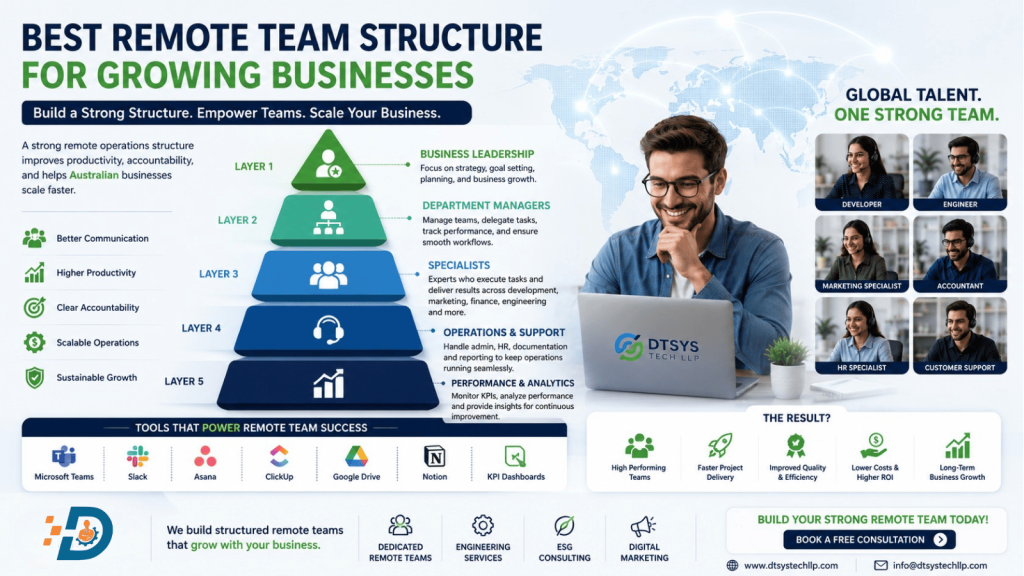
Best Remote Team Structure for Growing Australian Businesses Learn the best remote team structure to improve productivity, streamline operations, and help Australian businesses scale faster. DTSYS Tech June 23, 2026 7:33 am The Remote Team Blueprint Successful Australian Businesses Are Using to Scale Faster Building a remote team is easy. Building a high-performing remote team structure that consistently drives growth is the real challenge. Many Australian businesses are investing in remote workforce solutions, but not all of them succeed. The reason is simple: they focus on hiring people instead of building a system. Without a proper structure, remote teams can become disorganized, communication can break down, and productivity can suffer. The businesses growing fastest in 2026 are not necessarily hiring more people. They’re building smarter operational frameworks. A strong remote operations structure allows businesses to expand efficiently, improve accountability, and create sustainable growth. If your business is planning to scale, building the right remote team structure should be your first priority. Why Most Remote Teams Fail Remote work is no longer an experiment. However, many businesses still struggle because they lack structure. Common mistakes include: Undefined roles Poor communication channels No performance tracking Leadership bottlenecks Unclear reporting systems No standardized processes These problems create confusion and slow business growth. The solution isn’t hiring more people. The solution is creating a scalable remote team structure. What Is a Remote Team Structure? A remote team structure is an organized framework that defines how people collaborate, communicate, and achieve business goals. Instead of managing individuals, businesses manage systems. A successful remote operations structure includes: Leadership hierarchy Department ownership Communication systems Performance tracking Standard operating procedures Accountability frameworks When implemented correctly, teams become more productive and easier to scale. The Best Remote Team Structure for Growing Businesses Australian businesses can use a five-layer model to build scalable remote teams. Layer 1: Business Leadership This is your decision-making layer. Responsibilities include: Strategic planning Goal setting Budget allocation Business expansion Leadership focuses on growth instead of daily operations. Layer 2: Department Managers Every department needs ownership. Managers oversee: Team coordination Task delegation Workflow management Performance tracking This prevents business owners from becoming operational bottlenecks. Layer 3: Specialists 1. Remote Team Building We build dedicated remote teams that help businesses scale faster, reduce hiring costs, and access skilled global talent without geographical limitations. 2. Engineering Services We provide engineering expertise, technical design support, and project solutions that improve efficiency, productivity, and operational performance. 3. ESG Consulting We help businesses implement sustainable ESG strategies, improve compliance, reduce risks, and build long-term value and stakeholder trust. 4. Digital Marketing We create data-driven marketing strategies that increase brand visibility, generate qualified leads, and drive measurable business growth. Layer 4: Operations & Support This layer ensures smooth business operations. Responsibilities include: Administrative support HR coordination Documentation Reporting This creates operational stability. Layer 5: Performance & Analytics Every growing business needs data-driven decision-making. This layer monitors: Productivity metrics Team performance Project completion Workflow efficiency Businesses that measure performance grow faster. Why Structure Matters More Than Team Size Many business owners think growth means hiring more people. It doesn’t. Ten people with a structured workflow can outperform twenty people with poor systems. The goal is not headcount. The goal is operational efficiency. Businesses with strong remote team management systems experience: ✅ Better communication ✅ Faster project delivery ✅ Improved accountability ✅ Stronger collaboration ✅ Sustainable growth The Technology Stack Every Remote Team Needs A successful remote operations structure relies on technology. Australian businesses should implement tools for: Communication Microsoft Teams, Slack, or Google Meet. Project Management Asana, ClickUp, Trello, or Monday.com. Documentation Google Workspace or Notion. Performance Tracking Dashboards and KPI monitoring tools. Technology helps create visibility across teams. Why Australian Businesses Are Investing in Remote Team Management Businesses are no longer limited by local hiring markets. Remote workforce solutions help organizations: Access global talent Scale operations faster Reduce operational inefficiencies Improve workforce flexibility This creates a major competitive advantage. Companies with structured remote teams adapt faster to market changes. Why India Is Becoming a Global Hub for Remote Teams Australian businesses are increasingly building remote teams in India because of: Skilled professionals Technical expertise Excellent communication Scalable workforce availability International business experience This allows businesses to expand operations quickly and efficiently. How DTSYS Tech Builds High-Performance Remote Teams At DTSYS Tech, we don’t simply provide remote professionals. We build complete operational systems. Our services include: Remote Team Building Dedicated professionals tailored to your business goals. Engineering Services Engineering expertise and technical support. ESG Consulting Sustainability and governance expertise. Digital Marketing Performance-driven growth teams. Administrative Support HR and operational assistance. We manage: Talent sourcing Team onboarding Workflow integration Performance management Ongoing support Our objective is simple: Build a remote team that grows with your business. The Future of Business Is Built on Systems, Not Headcount The fastest-growing businesses are not hiring more people. They’re building smarter structures. Businesses with strong remote operations structures can: Scale faster Reduce operational friction Increase productivity Improve collaboration Support long-term growth The future belongs to businesses that build systems first and teams second. Final Thoughts A successful remote team isn’t built by chance. It is built through structure, accountability, and clear processes. Australian businesses that invest in remote team management today will create more agile and resilient organizations tomorrow. At DTSYS Tech, we help businesses build scalable remote teams designed for long-term success. Ready to Build Your Remote Team Structure? Partner with DTSYS Tech LLP and create a high-performing remote team that scales with your business. 👉 Book a Free Consultation 👉 Build Your Remote Team Today 👉 Start Growing Faster Follow Us On : Facebook Instagram Linkedin Best Remote Team Structure for Growing Businesses in Australia (FAQ) 1. What is a remote team structure? A remote team structure is a system that defines roles, workflows, communication, and performance management. 2. Why is remote team management important? It improves productivity, accountability, and helps businesses scale efficiently. 3. What departments can be built remotely? IT, engineering, marketing, finance,
Why Dedicated Remote Teams Outperform Freelancers in Australia

Why Dedicated Remote Teams Outperform Freelancers for Australian Businesses Discover why Australian businesses are replacing freelancers with dedicated remote teams to improve productivity, scalability, and long-term business growth. DTSYS Tech June 23, 2026 6:11 am Why Australian Businesses Are Moving Beyond Freelancers in 2026 Freelancers have become a popular option for businesses looking to complete short-term projects quickly. While freelancers can be useful for one-off tasks, many Australian businesses are realizing that freelancers alone cannot support long-term business growth. As businesses grow, they need more than individual contributors. They need consistency, accountability, collaboration, and scalability. This is why many companies are replacing fragmented freelancer models with dedicated remote teams. The question is no longer: “Should I hire a freelancer?” The better question is: “Should I build a dedicated remote team that can grow with my business?” For businesses focused on long-term growth, the answer is becoming increasingly clear. Dedicated remote teams deliver stronger operational outcomes than freelancers. The Freelancer Economy Is Growing, But So Are Its Limitations Hiring freelancers may initially seem simple. Businesses can quickly hire professionals for specific tasks without long-term commitments. However, as operations expand, businesses often encounter common problems. These include: Inconsistent availability Lack of accountability Communication gaps Knowledge loss Project dependency on one person Limited scalability For growing businesses, these challenges can slow down progress. Remote Teams vs Freelancers: What’s the Difference? A freelancer is typically an independent professional working on multiple projects for multiple clients. A dedicated remote team works exclusively as an extension of your business. This creates a major difference in performance. Freelancers focus on tasks. Dedicated remote teams focus on business outcomes & reduce operational costs Remote teams become integrated into your operations, processes, and long-term goals. This creates stability and operational continuity. Why Dedicated Remote Teams Outperform Freelancers 1. Dedicated Teams Offer Greater Accountability One of the biggest freelancer challenges is accountability. Freelancers often manage several clients simultaneously, which can impact priorities and response times. Dedicated remote teams work with clear KPIs and defined responsibilities. This creates: Better ownership Consistent communication Reliable execution Measurable performance Accountability drives long-term success. 2. Businesses Gain Long-Term Operational Stability Freelancers may leave projects unexpectedly. When this happens, businesses lose valuable knowledge and momentum. Dedicated staffing solutions create continuity. Team members remain aligned with: Business objectives Internal workflows Company processes Long-term projects This stability helps businesses grow confidently. 3. Collaboration Improves Significantly Modern businesses require teamwork. Freelancers often work independently, making cross-functional collaboration difficult. Dedicated remote teams operate together. Departments can collaborate efficiently across: Marketing Engineering Development Finance Customer support This creates smoother operations and faster execution. 4. Scaling Becomes Easier Freelancers are difficult to scale. Businesses may need to manage multiple freelancers individually, creating operational complexity. Dedicated remote teams allow businesses to: Add resources quickly Expand departments Build specialized teams Increase capacity efficiently This flexibility supports long-term growth. 5. Productivity Becomes More Consistent Business performance depends on consistency. Dedicated teams work with: Structured workflows Defined deadlines Shared systems Centralized communication This improves productivity and reduces operational delays. Consistency creates better business outcomes. Why Australian Businesses Are Moving Away from Freelancer Dependency Businesses no longer want temporary solutions. They want predictable growth systems. Dedicated remote teams help businesses: ✅ Improve productivity ✅ Reduce operational risk ✅ Increase accountability ✅ Strengthen collaboration ✅ Scale efficiently The result is a more stable and scalable business. Why India Is a Preferred Destination for Dedicated Staffing Australian businesses are increasingly building remote teams in India because of: Highly skilled professionals Strong communication abilities Global business experience Scalable workforce availability Faster onboarding This allows businesses to build reliable teams quickly. How DTSYS Tech Helps Businesses Build Dedicated Remote Teams At DTSYS Tech, we help Australian businesses transition from fragmented freelancer models to structured remote teams. We provide: 1. Remote Team Building We build dedicated remote teams that help businesses scale faster, reduce hiring costs, and access skilled global talent without geographical limitations. 2. Engineering Services We provide engineering expertise, technical design support, and project solutions that improve efficiency, productivity, and operational performance. 3. ESG Consulting We help businesses implement sustainable ESG strategies, improve compliance, reduce risks, and build long-term value and stakeholder trust. 4. Digital Marketing We create data-driven marketing strategies that increase brand visibility, generate qualified leads, and drive measurable business growth. We manage the complete process, including: Talent sourcing Candidate screening Team onboarding Workflow integration Performance management Ongoing support Our objective is simple: Build teams that grow with your business. The Future of Work Is Built Around Dedicated Teams Freelancers will always have a place in the market. However, businesses focused on long-term growth need scalable workforce solutions. Dedicated remote teams provide the structure, reliability, and performance businesses need to compete in today’s economy. The businesses that build dedicated teams today will have a major advantage tomorrow. Final Thoughts Freelancers are excellent for short-term tasks, but dedicated remote teams are designed for sustainable business growth. Australian businesses that want consistency, scalability, and operational efficiency are increasingly choosing dedicated staffing models. At DTSYS Tech, we help businesses build high-performing remote teams that deliver measurable results. Ready to Build a Dedicated Remote Team? Partner with DTSYS Tech LLP and replace workforce uncertainty with scalable growth. 👉 Book a Free Consultation 👉 Build Your Dedicated Remote Team 👉 Start Growing Faster Follow Us On : Facebook Instagram Linkedin Why Dedicated Remote Teams Outperform Freelancers in Australia (FAQ) 1. Why are dedicated remote teams better than freelancers? Dedicated remote teams provide accountability, consistency, and long-term business support. 2. What is the difference between freelancers and remote teams? Freelancers complete tasks, while remote teams integrate into your business operations. 3. Are dedicated remote teams more scalable? Yes. Businesses can easily expand departments and add specialists as they grow. 4. Which businesses benefit from dedicated staffing? IT, engineering, marketing, finance, customer support, and administrative businesses benefit significantly. 5. Why are Australian businesses moving away from freelancers? Businesses need more consistency, collaboration, and long-term workforce stability. 6. How does DTSYS Tech build dedicated remote